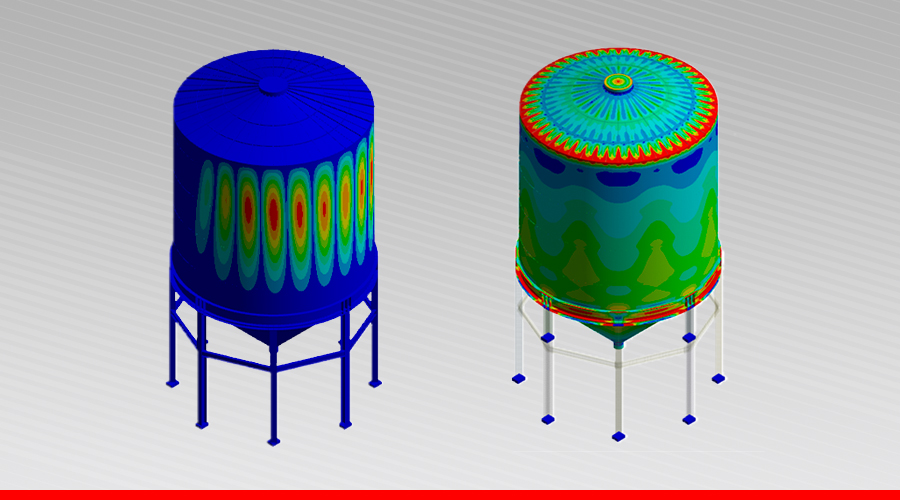
Introduction to the ASME Code Section VIII Div. 2 Using Ansys Mechanical
Subscribe now for $400.00-
Module 01 - Course Introduction
-
Module 02 - ASME Code
-
Module 03 - Design by Analysis
- Answer Key - Module 02
- Slides - Module 03
- Materials - Module 03
- Materials for Module 03 Quiz
- 3.1 Design by Analysis
- 3.2 Stress Linearization
- 3.3 Plastic Collapse and Localized Failure
- 3.4 Buckling and Fatigue
- 3.5 Workshop: Stress Linearization I
- 3.6 Workshop: Stress Linearization II
- 3.7 Workshop: Final Project I
- 3.8 Workshop: Final Project II
- 3.9 Workshop: Final Project III
- 3.10 Workshop: Final Project IV
- Quiz 03
-
Final Consideration
Description
Learn the fundamentals of applying the ASME Code Section VIII Division 2, using Ansys Mechanical, and gain an understanding of the requirements for modeling pressure vessels in both theory and practice.
The course guides students in understanding the characteristics of pressure vessels and the requirements of the ASME Code, presenting them theoretically and demonstrating modeling techniques and how to obtain results. Important concepts of the standard are discussed, such as the categorization of membrane and bending stresses and the linearization of stresses, among others.
Access period: 180 days with the single course purchase | 365 days with the Full Pass annual subscription and access to the entire course catalog
Category: Structural
General info
Content
- Course Introduction
- General Applications of Pressure Vessels
- Classification of Pressure Vessels
- Design Standards
- Introduction to the ASME Code
- Stress Classification and Types
- Description of Loads
- Stress Linearization
- Plastic Collapse – Elastic Analysis Method
- Plastic Collapse – Limit-Load Method
- Plastic Collapse – Elastic-Plastic Method
- Local Failure – Triaxial Stress Limit
- Buckling
- Fatigue
- Final Project in Ansys Mechanical
- Results Analysis and Project Validation
Objective
The objective of the course is to introduce the fundamentals of the ASME Code, Section VIII, Division 2, and its application using Ansys Workbench.
Target audience
Industry professionals, students, and academic professors interested in improving their knowledge in simulation techniques.
Methodology
Students have the flexibility to complete the training at the most convenient time in their daily routine. The videos, texts, and exercises have been prepared, reviewed, and structured in advance, allowing for optimal asynchronous use. Access to the educational platform is individual and non-transferable. Sharing access and downloading video materials is prohibited. If a student violates ESSS’s copyright rules, they may face the penalties provided by law. Access period: 180 days with the single course purchase | 365 days with the Full Pass annual subscription and access to the entire course catalog
Certificate
Upon full completion of the course, students receive an international certificate in electronic format, confirming completion of the course and the total number of hours completed. The certificate is issued by the ESSS Institute, a global leader in the field of computer simulation. ESSS ensures the quality of the course through its experience and recognition as a leader in computer simulation. With more than 300 employees, it is undoubtedly the largest CAE company in Latin America, with a portfolio of more than 800 companies worldwide. The faculty consists of ESSS faculty members holding doctoral and master’s degrees, as well as guest lecturers, all with solid backgrounds in teaching, research, and consulting.
Subscribe now
Subscribe now for $400.00